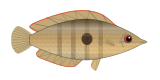
Demon eartheater
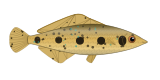
Satanoperca jurupari
A peaceful Amazon eartheater that lives in groups, sifts soft sand all day and asks for a very large tank with clean water.
Key facts
- Body length
- 7.3 in without fins
- Minimum tank
- 235 gallons
- Group
- 5+
- Temperament
- Peaceful
- Care level
- 4 / 5
- Lifespan
- Not well documented
- Diet
- Sinking granules, frozen bloodworm, brine shrimp and daphnia
- Origin
- Amazon basin, South America
- Hardier than41%
- Bigger than82%
- Calmer than68%
Water: their range vs yours
Demon eartheater tank mates
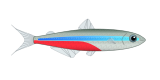
- Neon tetraGets along in shared water.Good mates
- Harlequin rasboraGets along in shared water.Good mates
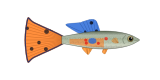
- Fancy guppyGets along in shared water.Good mates
- Panda corydorasGets along in shared water.Good mates
- OtocinclusGets along in shared water.Good mates
- Cherry shrimpGets along in shared water.Good mates
- BettaGets along in shared water.Good mates
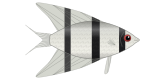
- AngelfishGets along in shared water.Good mates
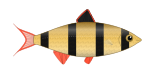
- Tiger barbGets along in shared water.Good mates
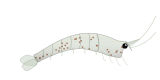
- Amano shrimpGets along in shared water.Good mates
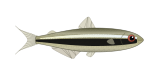
- Black neon tetraGets along in shared water.Good mates
- Black widow tetraGets along in shared water.Good mates
- Blue dolphin cichlidTwo territorial bottom-dwellers: need ≥ 18300 cm² of floor, tank has 5612 cm².Risky
- Bristlenose plecoTwo territorial bottom-dwellers: need ≥ 14400 cm² of floor, tank has 5612 cm².Risky
- Chinese algae eaterTwo territorial bottom-dwellers: need ≥ 19350 cm² of floor, tank has 5612 cm².Risky
- Convict cichlidTwo territorial bottom-dwellers: need ≥ 15300 cm² of floor, tank has 5612 cm².Risky
- DemasoniTwo territorial bottom-dwellers: need ≥ 18000 cm² of floor, tank has 5612 cm².Risky
- Fairy cichlidTwo territorial bottom-dwellers: need ≥ 16200 cm² of floor, tank has 5612 cm².Risky
- Iridescent sharkIridescent shark can eat Demon eartheater: prey body depth 7.4 cm ≤ mouth 32.5 cm.Avoid
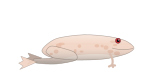
- African clawed frogAfrican clawed frog should only be kept in a single-species tank.Avoid
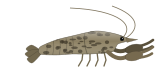
- Marbled crayfishMarbled crayfish should only be kept in a single-species tank.Avoid
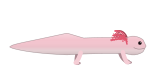
- AxolotlAxolotl should only be kept in a single-species tank.Avoid
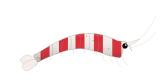
- Crystal red shrimpCrystal red shrimp should only be kept in a single-species tank.Avoid
- Jaguar cichlidJaguar cichlid can eat Demon eartheater: prey body depth 7.4 cm ≤ mouth 17.6 cm.Avoid
How we check
The numbers the tank model uses for demon eartheaters: water as ideal and tolerated ranges, bioload from adult mass, space, flow and how they act on other species.
- Standard length
- 18.5 cm (SL)
- Adult mass
- 189.95 g
- Bioload at 25 °C
- 23.29 BU
- Min. water
- 756 L net
- Min. footprint
- 210 × 60 cm per group
- Group
- 5+ (best 8)
- Swims in
- bottom
- Flow
- low
- Body / fins
- deep bodied, normal fins
- Diet type
- omnivore
- Fin nipper
- none
- Sensitive to
- —
Sources: Seriously Fish: Satanoperca jurupari
Care notes
Demon eartheaters grow to about 7.5 inches and spend the day sifting sand for food. They are calm, group-living fish that only get feisty when spawning, and they incubate their eggs in the mouth.
A group of five to eight needs a 7-foot tank of 180 gallons or more with soft sand. Keep the water very clean and avoid pushy bottom-dwelling cichlids, which bully them away from food.
Questions
What size tank does a demon eartheater need?
At least 235 gallons (756 litres of water after decor). Adults reach about 7.3 inches without fins.
How many demon eartheaters should be kept together?
Keep at least 5, ideally 8 or more: fewer feel exposed and hide or turn nippy.
What water do demon eartheaters need?
68–82 °F, pH 5.5–7.5 and 2–12 dGH. Demon eartheaters come from Amazon basin, South America.
How long do demon eartheaters live?
Not well documented with good care.
What fish can live with demon eartheaters?
Good tank mates include Neon tetra, Harlequin rasbora, Fancy guppy, Panda corydoras and Otocinclus. Each is checked both ways for size, fin nipping, temperament, territory and shared water.