Best fish for a 40 gallon tank
A 40 gallon breeder is wide and shallow, so it has the floor space for big groups of bottom dwellers and a calm community above them.
Checked by our tank model as a starter group in an empty, cycled 40G Breeder (91 × 46 × 41 cm) with a filter rated for it. One group per tank; mix species with the planner.
Possible, with care
- With care
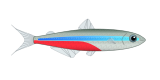
Neon tetra
Paracheirodon innesiTurnover 3.7/h is below the recommended 4/h.
group of 8 · 1.2 in · 17+ gal · 70–77°F · pH 5–7 - With care
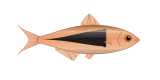
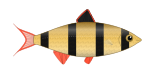
Harlequin rasbora
Trigonostigma heteromorphaTurnover 3.7/h is below the recommended 4/h.
group of 8 · 1.4 in · 17+ gal · 73–81°F · pH 6–7 - With care
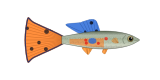
Fancy guppy
Poecilia reticulataGH 8 dGH is outside the Fancy guppy range 8–25 dGH.
group of 3 · 1.4 in · 13+ gal · 75–81°F · pH 7–8 - With care
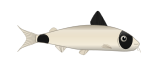
Panda corydoras
Corydoras pandaTurnover 3.7/h is below the recommended 4/h.
group of 6 · 1.6 in · 17+ gal · 72–77°F · pH 6–7.2 - With care
Otocinclus
Otocinclus vittatusTurnover 3.7/h is below the recommended 4/h.
group of 6 · 1.4 in · 17+ gal · 72–79°F · pH 6–7.2 - With care
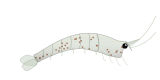
Cherry shrimp
Neocaridina davidiTurnover 3.7/h is below the recommended 4/h.
group of 10 · 1.6 in · 4+ gal · 72–75°F · pH 6.5–7.8 - With care
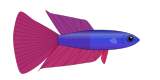
Betta
Betta splendensBetta: turnover 3.7/h is above the comfortable 3/h.
2.8 in · 11+ gal · 72–86°F · pH 6–7.5 - With care
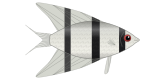
Angelfish
Pterophyllum scalareAngelfish: tank height 41 cm < 45 cm needed.
3.5 in · 32+ gal · 77–84°F · pH 6–7 - With care
Tiger barb
Puntigrus tetrazonaTiger barb: turnover 3.7/h is below 4/h.
group of 6 · 2.2 in · 32+ gal · 72–79°F · pH 6–7.5 - With care
Amano shrimp
Caridina multidentataTurnover 3.7/h is below the recommended 4/h.
group of 3 · 2 in · 7+ gal · 72–77°F · pH 6.5–7.5 - With care
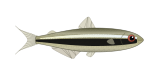
Black neon tetra
Hyphessobrycon herbertaxelrodiTurnover 3.7/h is below the recommended 4/h.
group of 8 · 1.4 in · 23+ gal · 73–81°F · pH 5.5–7.5 - With care
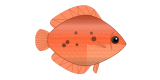
Blood parrot cichlid
hybridTurnover 3.7/h is below the recommended 4/h.
7.9 in · 36+ gal · 72–82°F · pH 6.5–8
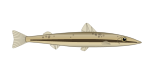
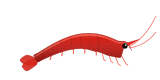
And 75 more in the species catalog.
Too much
- Avoid
Black widow tetra
Gymnocorymbus ternetzipH 7.2 is outside the Black widow tetra range 6.0–7.0.
group of 12 · 2.4 in · 22+ gal · 68–79°F · pH 6–7 - Avoid
Blue dolphin cichlid
Cyrtocara mooriiTemperature 76°F is outside the Blue dolphin cichlid range 77–84°F.
group of 3 · 9.8 in · 80+ gal · 77–81°F · pH 8–8.5 - Avoid
Chinese algae eater
Gyrinocheilus aymonieriChinese algae eater: tank length 91 cm < 168 cm needed.
group of 6 · 11 in · 95+ gal · 72–79°F · pH 6–8 - Avoid
Clown loach
Chromobotia macracanthuspH 7.2 is outside the Clown loach range 5.0–7.0.
group of 6 · 15.7 in · 202+ gal · 75–86°F · pH 5–7 - Avoid
Common pleco
Pterygoplichthys pardalisAmazon sailfin catfish (common pleco): needs a 650 L tank, this one is 172 L.
22.8 in · 203+ gal · 77–82°F · pH 7–7.5 - Avoid
Demasoni
Chindongo demasoni (syn. Pseudotropheus demasoni)pH 7.2 is outside the Demasoni range 7.6–8.8.
group of 6 · 3 in · 64+ gal · 75–82°F · pH 8.2–8.5 - Avoid
Discus
Symphysodon aequifasciatus (species complex)Temperature 76°F is outside the Discus range 79–86°F.
group of 5 · 5.5 in · 80+ gal · 79–86°F · pH 5–7 - Avoid
Fairy cichlid
Neolamprologus brichardipH 7.2 is outside the Fairy cichlid range 8.0–9.0.
group of 2 · 3.5 in · 34+ gal · 73–79°F · pH 8–9 - Avoid
Golden mbuna
Melanochromis auratuspH 7.2 is outside the Golden mbuna range 7.6–8.8.
group of 4 · 4.3 in · 64+ gal · 75–82°F · pH 7.6–8.8 - Avoid
Iridescent shark
Pangasianodon hypophthalmusIridescent shark: needs a 14580 L tank, this one is 172 L.
51.2 in · 4532+ gal · 72–79°F · pH 6.5–7.5 - Avoid
Kuhli loach
Pangio semicinctapH 7.2 is outside the Kuhli loach range 3.5–7.0.
group of 6 · 3.9 in · 17+ gal · 70–79°F · pH 3.5–7 - Avoid
Leopard sailfin pleco
Pterygoplichthys gibbicepspH 7.2 is outside the Leopard sailfin pleco range 5.0–7.0.
19.7 in · 187+ gal · 77–86°F · pH 5–7
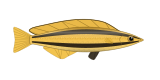
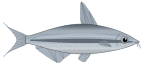
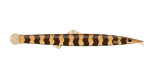
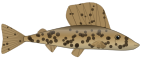
And 51 more in the species catalog.
How many fish fit in 40 gallons?
The old inch-per-gallon rule ignores body shape and group size. We estimate bioload from adult mass and water temperature, compare it with what the filter and weekly water changes remove, then add the space each species needs to swim and school.
The list above checks one species at a time. To mix several, add them to your own tank: the planner checks every pair and the combined load.
Every tank is different. Set yours up once (size, water, who already lives there) and each species is checked against it.
Plan my tank