Goldfish tank mates
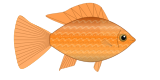
Goldfish are coldwater fish that grow big and eat anything that fits in their mouth. Most tropical community fish want warmer water, so the list of good mates is short.
Each species is checked against goldfish both ways: mouth size, fin nipping, temperament, territory, water overlap and keeper reports.
Good tank mates
- Fits
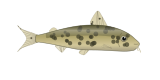
Peppered cory
Corydoras paleatusOne of the hardiest corys: a mottled catfish that sifts sand in a group of six and prefers slightly cooler water.
2.8 in · 22+ gal · 72–79°F · pH 6–7 - Fits
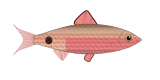
Rosy barb
Pethia conchoniusA large, hardy barb whose males turn bright pink-red when breeding; suits cooler tanks that run without a heater.
3.9 in · 28+ gal · 64–72°F · pH 6–8 - Fits
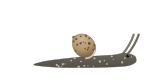
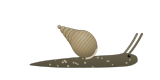
Bladder snail
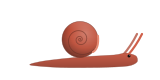
Physella acutaA small left-coiled snail that usually hitchhikes in on plants; a self-fertilising hermaphrodite, so a single one starts a colony.
0.6 in · 1+ gal · 63–84°F · pH 7–8 - Fits
Ramshorn snail
Planorbarius corneusThe classic flat-coiled snail every fishkeeper knows; it cleans up film and leftovers, breeds easily, and the red form is especially popular.
1.4 in · 4+ gal · 70–81°F · pH 7–8 - Fits
Denison barb
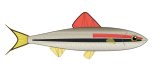
Sahyadria denisoniiA large, torpedo-shaped barb with a red line along its body; peaceful but very active, needing a long tank with flow and spotless water.
4.3 in · 76+ gal · 59–77°F · pH 6.8–7.8 - Fits
Giant danio
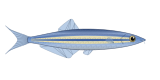
Devario aequipinnatusA big, fast danio with blue and gold stripes that needs a long tank, current, very clean water and a tight lid.
3 in · 76+ gal · 72–75°F · pH 6–8 - Fits
Gold barb
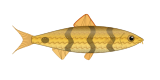
Barbodes semifasciolatusA golden aquarium form of the Chinese green barb; peaceful, hardy and happy in cooler tanks without a heater.
3 in · 26+ gal · 64–75°F · pH 6–8 - Fits
Great pond snail
Lymnaea stagnalisA large coldwater pond snail that breathes air at the surface and eats soft plants and other snails' eggs; for coldwater tanks, not tropical planted ones.
2 in · 7+ gal · 50–77°F · pH 7–8.5 - Fits
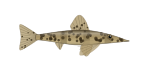
Butterfly hillstream loach
Beaufortia kweichowensisA flat 'butterfly' loach from southern Chinese rivers that clings to rocks and glass and wants cool, fast, oxygen-rich water.
3 in · 17+ gal · 61–75°F · pH 6.5–8
Risky
- With care
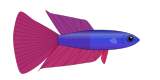
Betta
Betta splendensGoldfish needs cool water; bettas need tropical heat.
2.8 in · 11+ gal · 72–86°F · pH 6–7.5 - With care
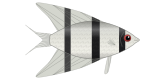
Angelfish
Pterophyllum scalareGoldfish needs cool water; angelfish need tropical heat.
3.5 in · 32+ gal · 77–84°F · pH 6–7 - With care
Black widow tetra
Gymnocorymbus ternetziGoldfish can eat young or small Black widow tetra; adults are big enough to be safe.
2.4 in · 22+ gal · 68–79°F · pH 6–7 - With care
Blood parrot cichlid
hybridGoldfish outcompetes the slow-eating Blood parrot cichlid for food; target-feed to make sure it eats.
7.9 in · 36+ gal · 72–82°F · pH 6.5–8 - With care
Blue dolphin cichlid
Cyrtocara mooriiBlue dolphin cichlid can eat young or small Goldfish; adults are big enough to be safe.
9.8 in · 80+ gal · 77–81°F · pH 8–8.5 - With care
Bristlenose pleco
Ancistrus cf. cirrhosusGoldfish needs cool water; bristlenose plecos need tropical heat.
4.9 in · 17+ gal · 70–79°F · pH 5.5–7.5 - With care
Bronze cory
Corydoras aeneusGoldfish needs cool water; bronze corys need tropical heat.
3 in · 23+ gal · 70–81°F · pH 6–8 - With care
Chinese algae eater
Gyrinocheilus aymonieriChinese algae eater eats slow fish: Goldfish (SF: присасывается к бокам крупных соседей, объедая слизь).
11 in · 95+ gal · 72–79°F · pH 6–8 - With care
Clown loach
Chromobotia macracanthusGoldfish needs cool water; clown loaches need tropical heat.
15.7 in · 202+ gal · 75–86°F · pH 5–7 - With care
Common pleco
Pterygoplichthys pardalisGoldfish needs cool water; common plecos need tropical heat.
22.8 in · 203+ gal · 77–82°F · pH 7–7.5 - With care
Convict cichlid
Amatitlania nigrofasciataConvict cichlid (aggressive) will bully the peaceful Goldfish.
5.9 in · 34+ gal · 75–82°F · pH 7–8 - With care
Demasoni
Chindongo demasoni (syn. Pseudotropheus demasoni)Goldfish needs cool water; demasoni need tropical heat.
3 in · 64+ gal · 75–82°F · pH 8.2–8.5
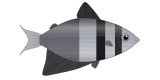
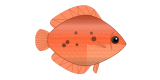
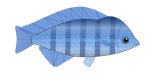
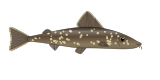
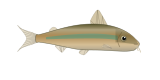
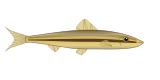
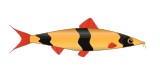
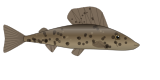
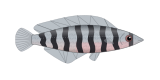
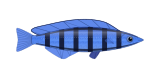
And 66 more in the species catalog.
Avoid
- Avoid
Neon tetra
Paracheirodon innesiGoldfish can eat Neon tetra: prey body depth 0.7 cm ≤ mouth 3.0 cm.
1.2 in · 17+ gal · 70–77°F · pH 5–7 - Avoid
Harlequin rasbora
Trigonostigma heteromorphaGoldfish can eat Harlequin rasbora: prey body depth 1.1 cm ≤ mouth 3.0 cm.
1.4 in · 17+ gal · 73–81°F · pH 6–7 - Avoid
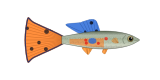
Fancy guppy
Poecilia reticulataGoldfish can eat Fancy guppy: prey body depth 0.8 cm ≤ mouth 3.0 cm.
1.4 in · 13+ gal · 75–81°F · pH 7–8 - Avoid
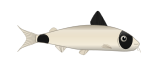
Panda corydoras
Corydoras pandaGoldfish can eat Panda corydoras: prey body depth 2.4 cm ≤ mouth 3.0 cm.
1.6 in · 17+ gal · 72–77°F · pH 6–7.2 - Avoid
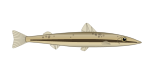
Otocinclus
Otocinclus vittatusGoldfish can eat Otocinclus: prey body depth 0.7 cm ≤ mouth 3.0 cm.
1.4 in · 17+ gal · 72–79°F · pH 6–7.2 - Avoid
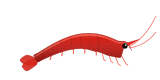
Cherry shrimp
Neocaridina davidiGoldfish can eat Cherry shrimp: prey body depth 0.8 cm ≤ mouth 3.0 cm.
1.6 in · 4+ gal · 72–75°F · pH 6.5–7.8 - Avoid
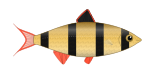
Tiger barb
Puntigrus tetrazonaTiger barbs shred goldfish fins.
2.2 in · 32+ gal · 72–79°F · pH 6–7.5 - Avoid
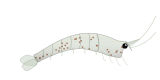
Amano shrimp
Caridina multidentataGoldfish can eat Amano shrimp: prey body depth 1.0 cm ≤ mouth 3.0 cm.
2 in · 7+ gal · 72–77°F · pH 6.5–7.5 - Avoid
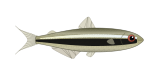
Black neon tetra
Hyphessobrycon herbertaxelrodiGoldfish can eat Black neon tetra: prey body depth 0.8 cm ≤ mouth 3.0 cm.
1.4 in · 23+ gal · 73–81°F · pH 5.5–7.5 - Avoid
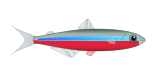
Cardinal tetra
Paracheirodon axelrodiGoldfish can eat Cardinal tetra: prey body depth 0.8 cm ≤ mouth 3.0 cm.
1.4 in · 17+ gal · 73–81°F · pH 4–6 - Avoid
Cherry barb
Puntius titteyaGoldfish can eat Cherry barb: prey body depth 1.1 cm ≤ mouth 3.0 cm.
2 in · 17+ gal · 73–81°F · pH 6–8 - Avoid
Glowlight tetra
Hemigrammus erythrozonusGoldfish can eat Glowlight tetra: prey body depth 0.9 cm ≤ mouth 3.0 cm.
1.6 in · 22+ gal · 75–82°F · pH 6–7.5
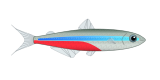
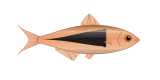
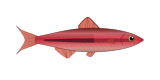
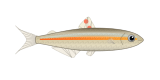
And 50 more in the species catalog.
Questions
Can goldfish live with tropical fish?
Rarely: goldfish like 18–22 °C, most tropical fish 24–28 °C, and goldfish eat small fish and shrimp.
Every tank is different. Set yours up once (size, water, who already lives there) and each species is checked against it.
Plan my tank